Stay up to date with latest news about technology, food, fashion, games, business and everything else that you need.

Showing posts with label TECH. Show all posts

Thursday, May 17, 2018

Bannon and Cambridge Analytica planned suppression of black voters, whistleblower tells Senate

https://ift.tt/2GpLtHc

Appearing before the Senate Judiciary committee today as part of the ongoing investigation of Cambridge Analytica and various forms of meddling in the 2016 elections, former employee and whistleblower Christopher Wylie said that the company and its then-VP Steve Bannon were pursuing voter suppression tactics aimed at black Americans.

Although Wylie insisted that he himself did not take part in these programs, he testified to their existence.

“One of the things that provoked me to leave was discussions about ‘voter disengagement’ and the idea of targeting African Americans,” he said. “I didn’t participate on any voter suppression programs, so I can’t comment on the specifics of those programs.”

“I can comment on their existence, and I can comment more generally on my understanding of what they were doing,” he explained under questioning from Sen. Kamala Harris (D-CA).

“If it suited the client’s objective, the firm [SCL, Cambridge Analytica’s parent company] was eager to capitalize on discontent and to stoke ethnic tensions,” read Wylie’s written testimony.

“Steve Bannon believes that politics is downstream from culture. They were seeking out companies to build an arsenal of weapons to fight a culture war,” he explained at another point in the session. He suggested questions on the nature of those weapons, and the specifics of any potential race-based voter suppression tactics, to be directed to Bannon.

That such a system might work, however, he did address.

“How specifically, then, did they target African American voters,” Sen. Harris had asked, “understanding as you do that the African American population is not a monolith? How did they then decipher and determine who was African American so they would target them in their intent to suppress the vote?”

“Racial characteristics can be modeled and I’m not sure about the studies that my colleague here was referencing but we were able to get an AUC score, which is a way of measuring accuracy for race that was .89 I believe,” Wylie answered.

AUC, he then explained, stands for “Area under the receiving operations characteristic. It’s a way of measuring precision, which [the .89 figure] means it’s very high.”

In other words, black voters could be identified based on their social media presence and other factors, despite the fact that the black community is, obviously, far from homogeneous.

It’s not particularly surprising that Bannon, who has aligned himself repeatedly with alt-right and white nationalist figures and movements, would be contemplating ways to decrease the number of people of color voting. But it is new that it was being pursued relatively openly under the Cambridge Analytica banner.

Sen. Harris and others requested any “evidence of the conduct you’ve described” Wylie may have.

Wylie also testified that Facebook, when it asked Cambridge Analytica to certify that it had deleted the data it was using in violation of the company’s rules, “did not require a notary or any sort of legal procedure. So I signed the certification and sent it back and they accepted it.”


TECH

TECH

via TechCrunch https://techcrunch.com

May 17, 2018 at 01:30AM
YouTube’s streaming music service is launching next week

https://ift.tt/2IsBGli


YouTube has announced that it’s launching YouTube Music – a new streaming service that brings millions of tracks and videos in both free and paid flavors – next week, on May 22.

The company says you’ll be able to find entire albums, covers, remixes, live versions, and artist radio stations in its new mobile and desktop apps. The app will also bring personalize your experience by surfacing tracks it thinks you might like on the home screen, and recommending playlists based on your listening history and location. Oh, and the search tool will also support esoteric queries or lyric lookups, similar to Google’s engine, like “that hipster song with the whistling.”

“It's both terrifyingly interesting and interestingly terrifying”

According to VICE, TNW Conference is quite the event

The free tier will be ad-supported, naturally – but if you’re already subscribed to Google Play Music or cough up $9.99 a month, you’ll get YouTube Music Premium, which allows for offline downloads, listening while the mobile app is in the background, and no ads.

It’s worth noting that Google was previously expected to replace Google Play Music with a YouTube-based service; it looks like that will indeed happen at some point, but it could take until 2019. So, for the time being, both services will be available.

That’s not all: there’s another subscription called YouTube Premium, which costs a bit more at $11.99 a month and brings YouTube Music Premium as well as access to all of the video platform’s content ad-free – including its original series and movies that were previously available to Red subscribers.

The new music service will see YouTube compete with the likes of Spotify, Apple Music, Pandora, Deezer, and its own Google Play Music. But it remains to be seen whether fans will take to it: on the one hand, YouTube has a huge library of content like alternative versions of songs that aren’t on other services, while rivals like Spotify boast a vibrant community and top-notch curation.

It’ll also be interesting to see what becomes of Google Play Music. While YouTube is set on killing it off at some point, it’ll need to secure all the necessary licensing approvals to make it available internationally.

YouTube Music will roll out on Tuesday, May 22, in the US, Australia, New Zealand, Mexico and South Korea. The company says it will subsequently become available in Austria, Canada, Denmark, Finland, France, Germany, Ireland, Italy, Norway, Russia, Spain, Sweden, Switzerland and the UK. You can sign up to be notified when the service arrives in your country on this page.

The Next Web’s 2018 conference is just a few days away, and it’ll be ðŸ’¥ðŸ’¥. Find out all about our tracks here.


TECH

TECH

via The Next Web https://thenextweb.com

May 17, 2018 at 08:29AM
Set Default Folder When Opening Explorer in Windows 10

https://ift.tt/2wQaTyc

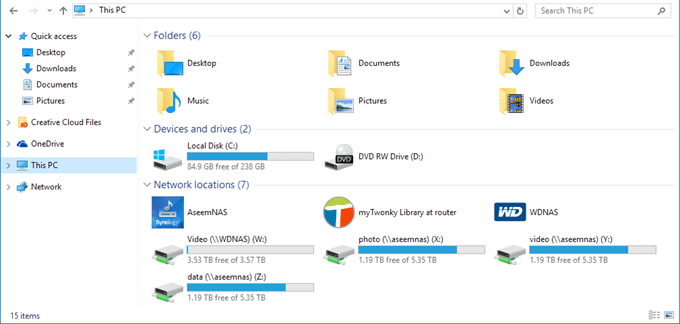
After upgrading to Windows 10 recently, I noticed that whenever I opened Explorer, it would always show me Quick Access. I like the new Quick Access feature, but I preferred to have Explorer open to This PC instead.

For me, being able to access the different drives on the computer and my network devices was far more important than accessing frequently used folders or recently opened files. It’s a useful feature, but I don’t mind having to click once to access it.

In this post, I’ll show you how to change the default folder from Quick Access to This PC when opening Explorer. In addition, I’ll also show you a trick whereby you can set any folder to be the default folder when opening Explorer in Windows 10.

Set Default Folder to This PC

To change the setting, open Explorer, click on File and then click on Change folder and search options.

change folder search options

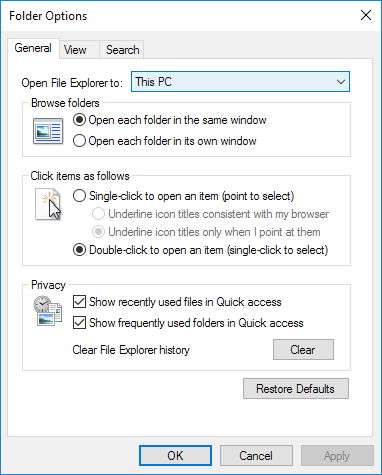
In the dialog that pops up, you should already be on the General tab. At the very top, you’ll see Open File Explorer to where you can select from This PC and Quick Access.

folder options windows 10

Just pick whichever folder you prefer and you’re good to go! Now when you open Explorer, you should see it open to This PC selected instead of Quick Access.

windows 10 this pc

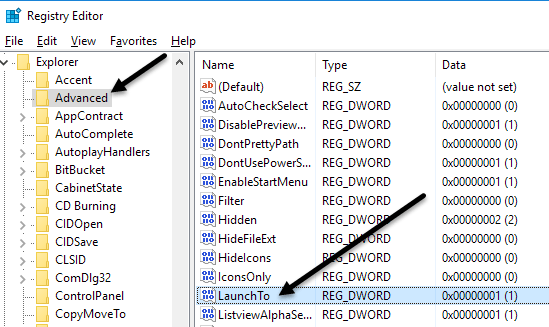
If you need to do this on many machines in a corporate environment, you’ll be happy to know that there is a registry entry that controls this setting also. Just navigate to the following key:

HKEY_CURRENT_USER\SOFTWARE\Microsoft\Windows\CurrentVersion\Explorer\Advanced

On the right hand side, look for a DWORD key named Launch To. 1 means This PC and 2 means Quick Access.

registry editor windows

Finally, let’s talk about how we can configure Explorer to open up to any folder as the default folder.

Set Any Folder as Default for Explorer

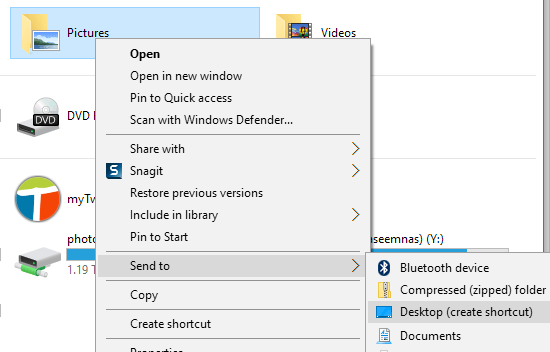
Since there really isn’t any official way to do this, we have to kind of hack Windows to get it to do what we want. I’ve tested it out and the process seems to work just fine. To get started, find your folder and create a shortcut to the folder on your desktop.

create desktop shortcut

For example, if I wanted to use the Pictures folder as my default folder, I would right-click on it, choose Send to and then click on Desktop (create shortcut). Next, we need to copy that shortcut into a special location in Windows. First, let’s open Explorer and go to that special location. Just copy and paste the following path into the address bar in another Explorer window:

%APPDATA%\Microsoft\Internet Explorer\Quick Launch\User Pinned\TaskBar

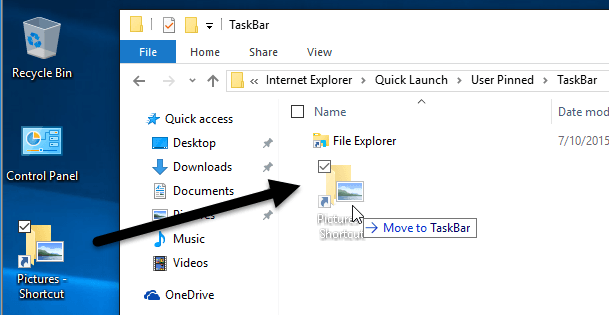
Make sure to press Enter after you paste the path into Explorer. Depending on what else is pinned to your taskbar, you might see shortcuts to several programs here, but you should always see a File Explorer shortcut.

drag shortcut

Now go ahead and drag the shortcut that we just created from your desktop into the special folder you have open in Explorer. Now we have to do one last thing. Go ahead and delete the File Explorer shortcut and rename the Pictures Shortcut to File Explorer. If you chose a different folder than Pictures, then change whatever the name of that shortcut is to File Explorer.

file explorer windows

That’s about it! Now open File explorer from your taskbar and you should be viewing the contents of whichever folder you chose to be the default folder.

pictures folder windows

It’s worth noting that this little trick will only work when you click on the Explorer icon on your taskbar. If you open Explorer by double-clicking on This PC on the desktop or by clicking on Start and then File Explorer, you’ll either see This PC or Quick Access, depending on which option is chosen in the settings.

If you want to undo what we just did above, all you have to do is right-click on Explorer in the taskbar and choose Unpin from taskbar. After that, just drag the This PC icon from your desktop and drop it onto the taskbar again. This will create a new Explorer shortcut and it’ll work normally.

Pin Folders to Quick Access

If you don’t like any of the two options above, you do have one other choice in Windows 10. You could use the new pinned folders feature that is associated with Quick Access. When you open Explorer, you’ll see a pin icon next to several folders under Quick Access.

pinned folders

The Desktop, Downloads, Documents, Pictures, This PC and Music folders are pinned by default in Windows 10. If you want to remove any of them, just right-click and choose Unpin from Quick Access.

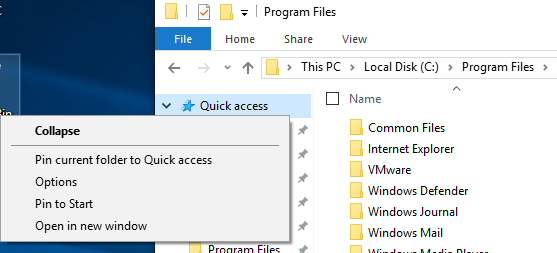
However, if you want one click access to any folder on your computer, navigate to that folder, then right-click on Quick Access and choose Pin current folder to Quick Access.

pin folder quick access

As you can see, this is how I pinned the Program Files folder to my Quick Access section. Using this method, you don’t have to resort to any hacks and you can also quickly access any folder on your system with two clicks.

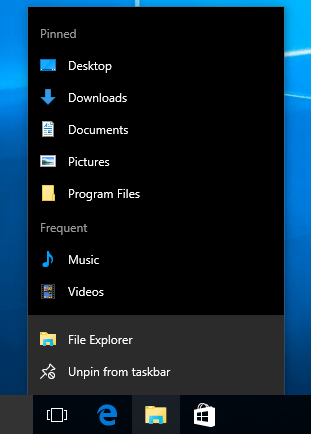
Lastly, you can also get to that pinned folder quickly by simply right-clicking on the File Explorer icon in your taskbar and choosing your pinned folder, which will show up in the jumplist.

explorer jump list

So in summary, if you want to change the default folder system-wide, you can only pick between This PC and Quick Access. If you use the second method involving the shortcut hack, then you have to use the shortcut from the taskbar.

Lastly, if you just need quick access to a folder, try using the pin to Quick Access option as that will also be system-wide and will remain in the left-hand side even as you browse through other folders. If you have any questions, post a comment. Enjoy!


TECH


via Online Tech Tips https://ift.tt/2x1MZxu

May 17, 2018 at 01:58AM
Monitor Hidden Website and Internet Connections

https://ift.tt/2Go3p55

You can be pretty sure that your computer is connected to the server hosting my website as you read this article, but in addition to the obvious connections to the sites open in your web browser, your computer may be connecting to a whole host of other servers that are not visible.

Most of the time, you’re really not going to want to do anything written in this article since it requires looking at a lot of technical stuff, but if you think there is a program on your computer that shouldn’t be there communicating secretly on the Internet, the methods below will help you identify anything unusual.

It’s worth noting that a computer running an operating system like Windows with a few programs installed will end up making a lot of connections to outside servers by default. For example, on my Windows 10 machine after a reboot and with no programs running, several connections are made by Windows itself, including OneDrive, Cortana and even desktop search. Read my article on securing Windows 10 to learn about ways you can prevent Windows 10 from communicating with Microsoft servers too often.

There are three ways you can go about monitoring the connections that your computer makes to the Internet: via the command prompt, using Resource Monitor or via third-party programs. I’m going to mention the command prompt last since that’s the most technical and hardest to decipher.

Resource Monitor

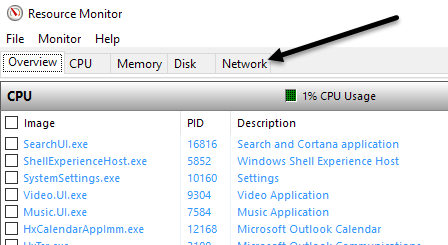
The easiest way to check out all the connections your computer is making is to use Resource Monitor. To open it, you have to click on Start and then type in resource monitor. You’ll see several tabs across the top and the one we want to click on is Network.

resource monitor

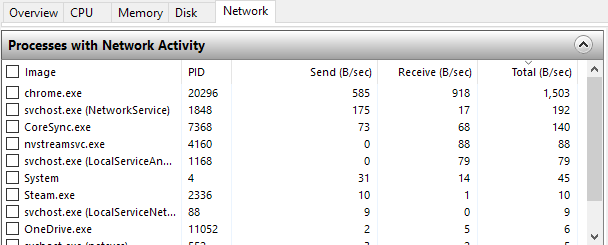
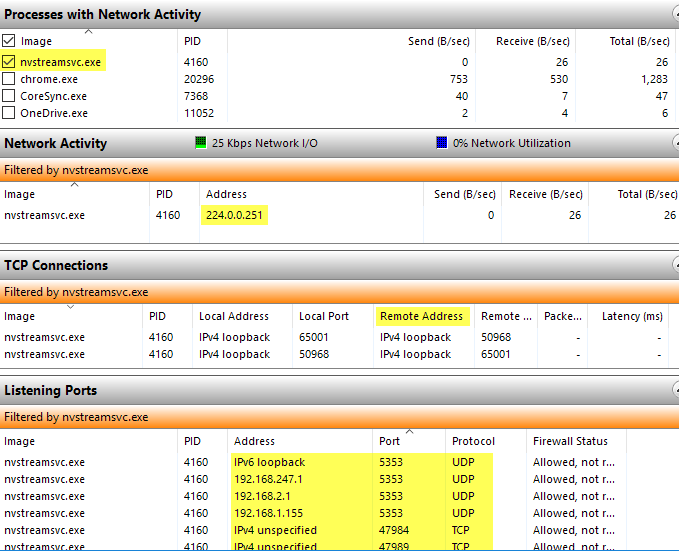
On this tab, you’ll see several sections with different types of data: Processes with Network Activity, Network Activity, TCP Connections and Listening Ports.

resource monitor processes

All the data listed in these screens are updated in real time. You can click on a header in any column to sort the data in ascending or descending order. In the Processes with Network Activity section, the list includes all the processes that have any kind of network activity. You’ll also be able to see the total amount of data sent and received in bytes per second for each process. You’ll notice there is an empty checkbox next to each process, which can be used as a filter for all the other sections.

For example, I wasn’t sure what nvstreamsvc.exe was, so I checked it and then looked at the data in the other sections. Under Network Activity, you want to look at the Address field, which should give you an IP address or the DNS name of the remote server.

filter process resource monitor

In and of itself, the information here won’t necessarily help you figure out whether something is good or bad. You have to use some third-party websites to help you identify the process. Firstly, if you don’t recognize a process name, go ahead and Google it using the full name, i.e. nvstreamsvc.exe.

search for process

Always, click through at least the first four to five links and you’ll instantly get a good idea of whether or not the program is safe or not. In my case, it was related to the NVIDIA streaming service, which is safe, but not something I needed. Specifically, the process is for streaming games from your PC to the NVIDIA Shield, which I don’t have. Unfortunately, when you install the NVIDIA driver, it installs a lot of other features you don’t need.

Since this service run in the background, I never knew it existed. It didn’t show up in the GeForce panel and so I assumed I just had the driver installed. Once I realized I didn’t need this service, I was able to uninstall some NVIDIA software and get rid of the service, which was communicating on the network all the time, even though I never used it. So that’s one example of how digging into each process can help you not only identify possible malware, but also remove unnecessary services that could possibly be exploited by hackers.

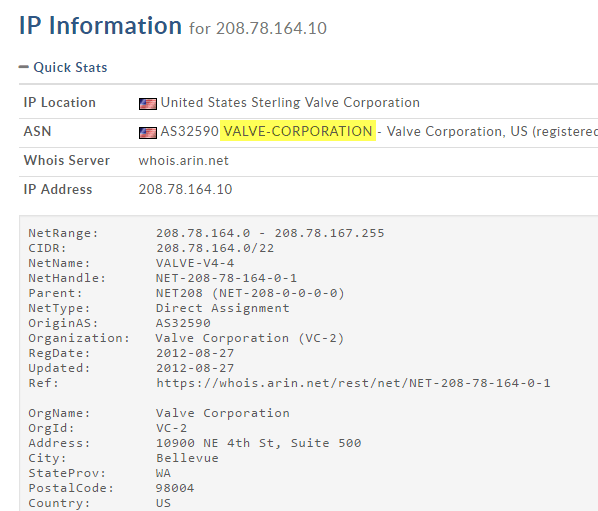
Secondly, you should look up the IP address or DNS name listed in the Address field. You can check out a tool like DomainTools, which will give you the information you need. For example, under Network Activity, I noticed that the steam.exe process was connecting to IP address 208.78.164.10. When I plugged that into the tool mentioned above, I was happy to learn that the domain is controlled by Valve, which is the company that owns Steam.

whois ip address

If you see an IP address is connecting to a server in China or Russia or some other strange location, you might have a problem. Googling the process will normally lead you to articles on how to remove the malicious software.

Third Party Programs

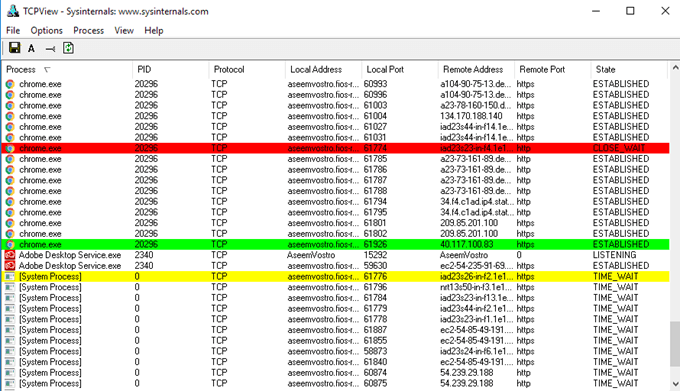
Resource Monitor is great and gives you a lot of info, but there are other tools that can give you a little bit more information. The two tools that I recommend are TCPView and CurrPorts. Both pretty much look exactly the same, except that CurrPorts gives you a whole lot more data. Here’s a screenshot of TCPView:

tcpview

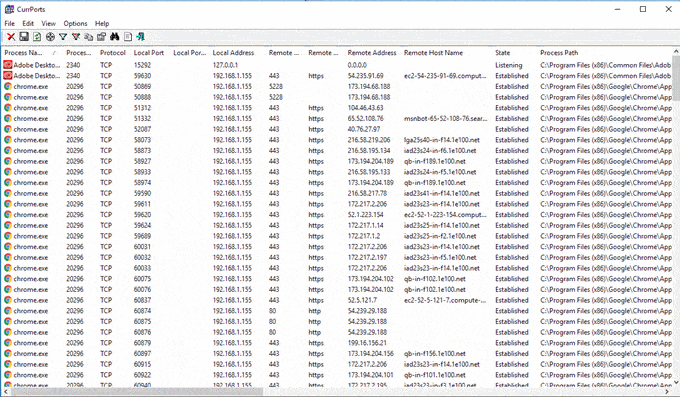
The rows you are mostly interested in are the ones that have a State of ESTABLISHED. You can right-click on any row to end the process or close the connection. Here’s a screenshot of CurrPorts:

currports

Again, look at ESTABLISHED connections when browsing through the list. As you can see from the scrollbar at the bottom, there are many more columns for each process in CurrPorts. You can really get a lot of information using these programs.

Command Line

Finally, there is the command line. We will use the netstat command to give us detailed information about all the current network connections outputted to a TXT file. The information is basically a subset of what you get from Resource Monitor or the third-party programs, so it’s really only useful for techies.

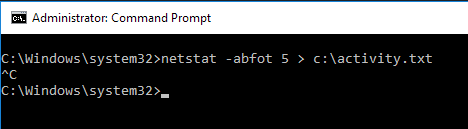
Here’s a quick example. First, open an Administrator command prompt and type in the following command:

netstat -abfot 5 > c:\activity.txt

netstat command

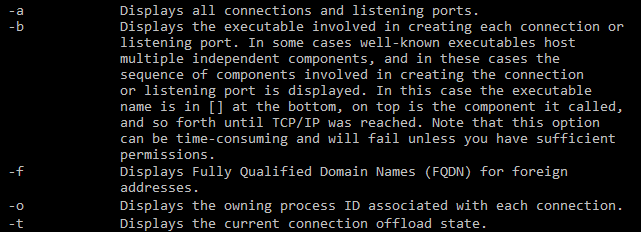
Wait for about a minute or two and then press CTRL + C on your keyboard to stop the capture. The netstat command above will basically capture all network connection data every five seconds and save it to the text file. The –abfot part is a bunch of parameters so that we can get extra information in the file. Here is what each parameter means, in case you are interested.

netstat command help

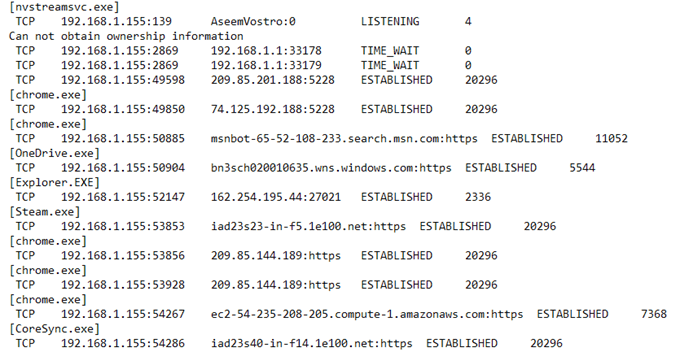
When you open the file, you’ll see pretty much the same information that we got from the other two methods above: process name, protocol, local and remote port numbers, remote IP Address/DNS name, connection state, process ID, etc.

netstat output

Again, all of this data is a first step to determining whether something fishy is going on or not. You’ll have to do a lot of Googling, but it’s the best way to know if someone is snooping on you or if malware is sending data from your computer to some remote server. If you have any questions, feel free to comment. Enjoy!


TECH


via Online Tech Tips https://ift.tt/2x1MZxu

May 17, 2018 at 01:50AM
MacBook vs MacBook Air vs MacBook Pro with Retina Display

https://ift.tt/2IlTZN3

Considering buying a MacBook over a Windows laptop, but not sure which one to get or when? Well, even though you have only a handful of choices when it comes to Macs compared to the plethora of Windows options, it’s still not necessarily an easy decision, especially considering you have to shell out a lot more money on a Mac.

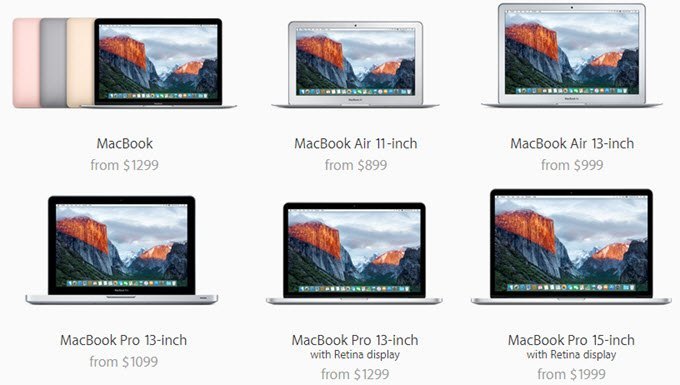
As of now, you have the following choices when it comes to Mac laptops: The new 12-inch Retina MacBook, the older MacBook Air, the 13-inch non-Retina MacBook Pro and the 13 and 15-inch Retina MacBook Pros.

In this article, I’m going to discuss the differences between these models and also talk about the current state of all the MacBooks and whether or not you should even bother buying a Mac, especially right now (June 2016).

mac laptops

Wait, or Buy Now?

The first thing you should ask yourself is whether or not you should buy a Mac right now. Apple creates great products and their hardware definitely includes some of the best designed laptops on the market.

With that, Apple also tends to release these great products at very large time intervals. By the time they release their next great version of a particular laptop, which could take years, Windows laptops will have copied and surpassed the Mac.

Take, for example, the MacBook Air. It was released about 6 years ago and the design hasn’t changed a bit. Of course, the internals have been upgraded, but not as fast as on Windows laptops. They still have Intel Broadwell (5th generation) chips whereas you can easily buy a Windows laptop with a Skylake processor (6th generation).

My first recommendation is to go to the MacRumors Buying Guide and follow the advice there. Their recommendations are always current, so even if you are reading this article 6 months from now, their recommendations for when to buy will always be more accurate than what I can try to predict. Note that you should only use this guide as a way to determine whether you should buy a particular Mac right now or not. It’s not really a guide to help you decide which Mac to buy.

mac buying guide

As you can see with all the red, most of the recommendations at this point are to not buy. This is because most of the laptops haven’t been updated in a very long time and paying full price for a machine that has parts that are several years old just doesn’t make any sense.

In my opinion, no one should ever buy the regular non-Retina MacBook Pro. It’s expensive and it has been updated in almost 1500 days. So that basically leaves you with the Retina MacBook Pro, MacBook Air and MacBook.

According to most rumor sites, we’ll see big upgrades to the Macs in September or October of 2016, in which case the Retina MacBooks will be the clear choice for power users. On the less expensive side, it’ll be tough to say. Some people are saying that the MacBook Air will be removed since it’s very similar to the new 12-inch MacBook, which is a much better option right now over the Air. Now let’s talk about the differences between the laptops.

Retina Display

The biggest difference in my opinion between the different laptops is retina vs non-retina. A retina display basically has more pixels packed onto the screen, giving you a higher resolution than 1080p. So far, on the Mac laptops, retina does not mean 4K. You can only get a 4K or 5K display from Apple if you buy an iMac.

There are Windows laptops from Dell, etc. that have 4K screens, but everything is scaled up because a 4K native resolution on a 15 inch or 13 inch screen would make everything extremely tiny. What I like about the Mac retina resolutions is that you can keep it at the native resolution and still use the computer (if you like things small, but not tiny).

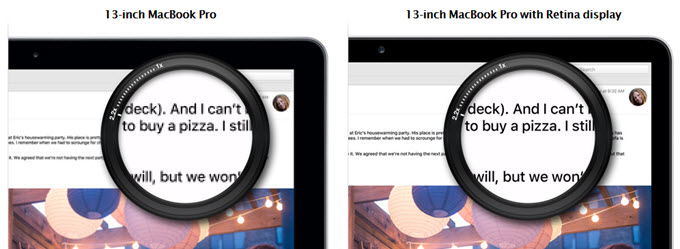
retina vs non-retina

If you’ve never used a retina display, then you can still consider buying a non-retina laptop. Once you have used a retina display, however, you will find it very painful to go back to a non-retina display. Everything is much clearer and crisp and make a big difference, especially if you are in front of the computer for several hours a day.

Each retina Mac has a slightly different resolution because of the size:

12-inch MacBook - 2304x1440
13-inch MacBook Pro w/Retina - 2560x1600
15-inch MacBook Pro w/Retina - 2880x1800

If you can get a Mac laptop with a retina display, you will be much happier with your purchase. The only advantages to buying a MacBook Air are that you can get a slightly bigger screen size (13.3 inches), a slightly faster processor (up to a dual-core i7), slightly better battery life and a couple of USB and Thunderbolt 2 ports. Other than that, the 12-inch MacBook beats out the Air on everything else.

For me, personally, the retina display makes up for any of the other small disadvantages. If you’re going for the higher end MacBook Pro laptops, don’t even bother with the non-retina display option. That’s probably going to be eliminated very soon anyway.

Ports

I mention ports next because this could be a deciding factor for some. On the 12-inch MacBook, for example, there is literally just one port: USB-C port. This is a new iteration of USB and will probably be the future of USB, but not many devices use USB-C yet.

macbook ports12-inch MacBook

This means if you need to connect anything to the MacBook, even a regular USB flash drive, you’ll need an adapter. This can be annoying for some and not worth the slim size and light weight. Also, the USB-C port is used to power and charge the laptop also.

On the MacBook Airs, both the 11-inch and 13-inch almost have the same number of ports: two USB 3 ports and one Thunderbolt 2 port. The 13-inch model also has a SDXC card slot, which you can use for transferring pictures and videos from your camera, etc.

macbook air 13in ports13 inch MacBook Air

Both models have an audio-out jack and a MagSafe port for power. Next, we have the retina MacBook Pros (13 inch and 15 inch). Luckily, both of them have the same exact ports: two USB 3 ports, two Thunderbolt 2 ports, one HDMI port, and one SDXC card slot.

retina macbook portsRetina MacBook Pro

Lastly, even though you shouldn’t buy one, the non-retina MacBook Pro has a couple of ports not available on the other laptops. If you really need an Ethernet port or a Firewire port, then this laptop has it. It does not have an HDMI port, however.

Weight & Dimensions

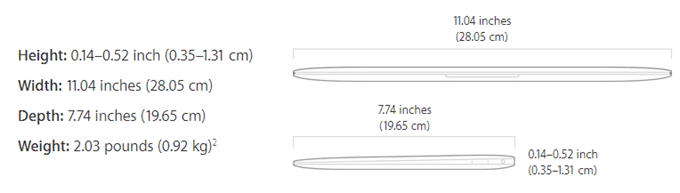
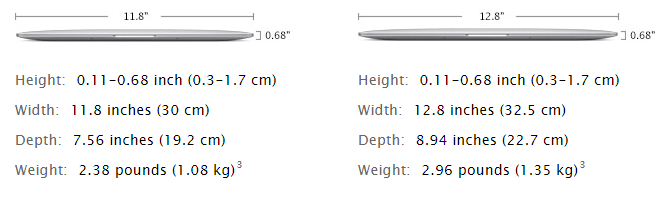
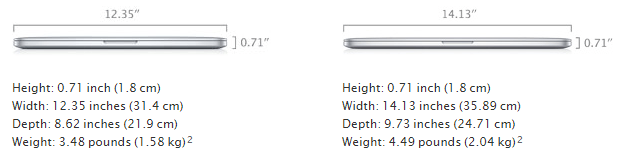
Another major factor in choosing a model is the weight and dimensions of the laptop. If you are a road warrior and take your laptop everywhere, the 12-inch MacBook is super-light and super-thin. The MacBook Airs are also very light and thin, but not as much as the 12-inch. Finally, the retina MacBook Pros are the thickest and heaviest, but also have the most power in terms of CPU and graphics. Here are the size and weight specs for each laptop:

12-inch MacBook

macbook size weight

11 & 13 inch MacBook Airs

macbook air size weight

13 & 15 inch Retina MacBook Pros

macbook pro size and weight

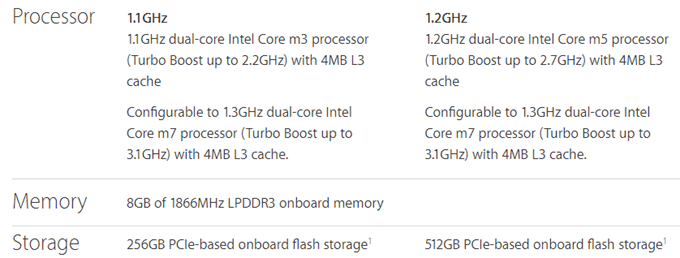
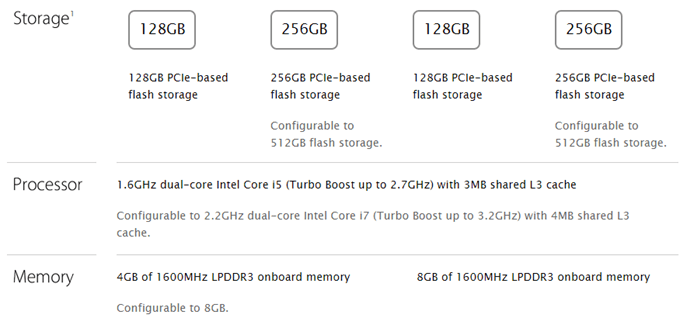
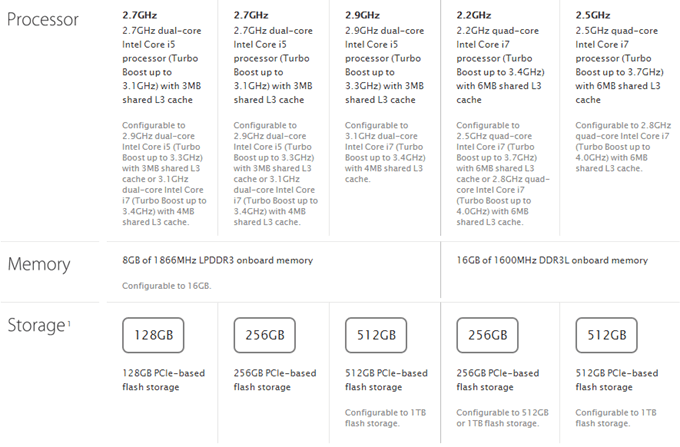
CPU, Memory & Storage

The rest of the specs like CPU, memory and storage really all come down to your use case. If you want to do heavy video editing using Final Cut Pro, then it’s probably a smart idea to get a Mac with an SSD, a core i5 or i7 processor and at least 16 GB of RAM.

If you absolutely need 16GB of RAM, then you have to purchase a Retina MacBook Pro. If you want 512 GB of flash storage, then you can cut out the MacBook Airs since they only go up to 256 GB.

The other big differences here are the CPUs used inside each laptop. The 12-inch MacBook uses Intel Core m3, m5, or m7 processors. These are kind of like the Intel Celeron processors back in the day. The MacBook Airs move up to dual-core i5 and i7 processors. Finally, the retina MacBooks Pros move up to quad-core i7 processors (on the 15 inch).

Here’s the breakdown for each laptop:

12-inch MacBook

macbook cpu ram

11 & 13 inch MacBook Airs

macbook air cpu ram

13 & 15 inch Retina MacBook Pros

retina macbook pro cpu ram

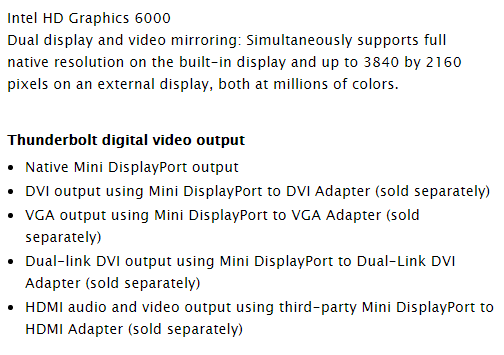
Graphics & Video

Finally, the last major difference between the laptops is the graphics card. It’s worth noting that the only machine with a discrete graphics card is the 15 inch Retina MacBook Pro. So if you want a discrete graphics card, you only have one option.

However, it’s also worth noting that Macs are not good setups for gaming. Don’t buy the 15 inch Retina MacBook pro for gaming because you will be disappointed. If you work with CAD applications, video editing, etc., then it’s a good choice.

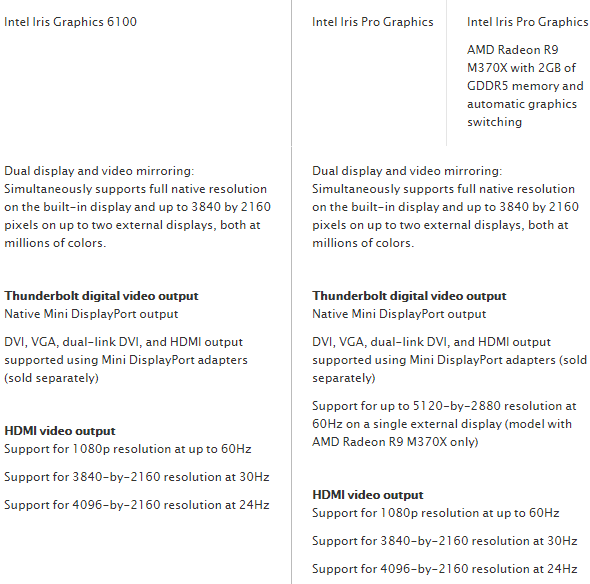
Both the 12-inch MacBook and the MacBook Air can output to the computer display and to an external display at 3840×2160 at the same time. On the MacBook Air, you can also output to DisplayPort, DVI, VGA or HDMI using the Thunderbolt 2 port and an adapter.

On the retina MacBook Pros, you can connect up to three external monitors. On the 15-inch with the R9 M370X graphics card, you can actually output to a single 5K monitor at 60Hz. Here are the full specs for each laptop:

12-inch MacBook

macbook graphics

11 & 13 inch MacBook Airs

macbook air graphics

13 & 15 inch Retina MacBook Pros

retina macbook pro video

Conclusion

There are other minor differences between the machines, obviously, but I don’t think they are deciding factors when making the purchase. For example, the 12-inch MacBook comes with a 480p FaceTime camera, which is just bad, but not the end of the world.

Battery life on all the machines is pretty good for a laptop and not something you really have to worry about. As mentioned, don’t ever buy the non-retina MacBook Pro and don’t buy anything other than the 12-inch MacBook until the end of 2016, when hopefully everything gets a major refresh internally and externally. Enjoy!


TECH


via Online Tech Tips https://ift.tt/2x1MZxu

May 17, 2018 at 01:49AM

Wednesday, May 16, 2018

Facebook says it took down 583 million fake accounts in Q1 2018

https://ift.tt/2Ghwb76


As Facebook continues to grapple with spam, hate speech, and other undesirable content, the company is shedding more light on just how much content it is taking down or flagging each day.

The company today published its first-ever Community Standards Enforcement Report today, detailing what kind of action it took on content displaying graphic violence, adult nudity and sexual activity, terrorist propaganda, hate speech, and spam. One of the most noteworthy numbers: Facebook said that it took down 583 million fake accounts in the three months spanning Q1 2018, down from 694 million in Q4 2017. That doesn’t include what Facebook says are “millions” of fake accounts that the company catches before they can finish registering with Facebook.

The report comes just a few weeks after Facebook published for the first time detailed internal guidelines for how it enforces content takedowns.

The numbers give users a better idea of the sheer volume of fake accounts Facebook is dealing with as it has pledged in recent months to use facial recognition technology — which the company also uses to suggest which Facebook friends to tag in photos — to catch fake accounts that might be using another person’s photo in their profile pictures. But a recent report from the Washington Post found that Facebook’s facial recognition technology may not be that effective yet in catching fake accounts, as the tool mostly searches within a user’s friends network or their friends of friends to catch fake accounts.

Facebook also gave a breakdown of how much other undesirable content it removed during Q12018, as well as how much of it was flagged by its systems or reported by users:

  • 21 million pieces of content depicting inappropriate adult nudity and sexual activity was taken down, 96 percent of which was first flagged by Facebook’s tools.
  • 3.5 million pieces of violent content was taken down or slapped with a warning label, 86 percent of which was flagged by Facebook’s tools.
  • 2.5 million pieces of hate speech was taken down, 38 percent of which was flagged by Facebook’s tools.

The numbers show that Facebook is still predominately relying on other people to catch hate speech — which CEO Mark Zuckerberg has spoken about before, saying that it’s much harder to build an AI system that can detect what is hate speech then to build a system that can detect a nipple, for instance. Facebook defines hate speech as a “direct attack on people based on protected characteristics—race, ethnicity, national origin, religious affiliation, sexual orientation, sex, gender, gender identity, and serious disability or disease.”

The problem is that, as Facebook’s VP of product management Guy Rosen wrote in the blog post announcing today’s report, AI systems are still years away from becoming effective enough to be relied upon to catch most bad content.

But, hate speech is a problem for Facebook today, as the company’s struggle to stem the flow of fake news and content meant to encourage violence against Muslims in Myanmar has shown.  And Facebook’s failure to properly catch hate speech could push users off the platform before the company develops an AI solution.


TECH

FINANCE

via VentureBeat https://venturebeat.com

May 15, 2018 at 06:28PM
Twitter is now using ‘behavioral signals’ to mute trolls in conversations and search

https://ift.tt/2Gio1ve


Reuters – Twitter Inc on Tuesday revised its strategy for fighting abusive internet “trolls,” saying it would use behavioral signals to identify harassers on the social network and then limit the visibility of their tweets.

San Francisco-based Twitter, known for freewheeling discussions since it was founded in 2006, has been trying to rid itself of harassment out of concern that personal attacks were driving people away.

Twitter’s rules already prohibit abuse, and it can suspend or block offenders once someone reports them. Users can also mute people they find offensive.

Chief Executive Jack Dorsey said Twitter now would try to find problematic accounts by examining behavior such as how frequently people tweet about accounts that do not follow them or whether they have confirmed their email address.

Tweets from those accounts will appear lower in certain areas of the service, such as search results or replies to tweets, even if the tweets themselves have not been found to violate any rules.

“We want to take the burden of the work off the people receiving the abuse or the harassment,” Dorsey said in a briefing with reporters. Past efforts to fight abuse “felt like Whac-A-Mole,” he added.

Tweets will not be removed entirely based on behavioral signals, Dorsey said.

In tests the new approach resulted in a 4 percent decrease in abuse reports originating from search results and an 8 percent decrease in abuse reports from the conversations that take place as replies to tweets, according to the company.

Most abuse comes from a small number of accounts that have an outsized impact, said Del Harvey, Twitter’s vice president for trust and safety.

Social media firms including Twitter and Facebook are under pressure to remove bullies, many of whom target women and minorities. Many women cannot express themselves freely on Twitter without fear of violence, Amnesty International said in a report in March.

Reducing abuse could also help Twitter’s business. If more people sign up and spend time on the service, marketers may buy more ads on it.

Dorsey said that Twitter’s 336 million monthly active users should expect a series of other changes over the next several months as the company explores ways to encourage tweets that are more civil.

In March, Twitter sought proposals from academics and others to help gauge the “health of public conversations.” Dorsey said the company is reviewing 230 submissions it received.

Reporting by David Ingram; Editing by Leslie Adler

This story originally appeared on Reuters.com. Copyright 2018


TECH

FINANCE

via VentureBeat https://venturebeat.com

May 15, 2018 at 08:58PM
10 Most Bizarre Flying Machines in Aviation History

https://ift.tt/1liBypv

The invention of elaborately constructed flying machines to travel through the Earth’s atmosphere ranks among mankind’s greatest innovations. The field of aviation is defined by challenging the limits and coming up with bold new ideas, but these aircraft simply defy all concepts of normalcy.

10. Convair V2 Sea Dart

http://www.column5.us/triebe/wp-content/uploads/2012/08/f2y4.jpg

To supplement standard aircraft, a variety of interesting combination machines are available to pilots. However, a jet fighter designed to land right in the ocean adds an entirely new definition to the job description, turning pilots into jet ski operators. The Convair Sea Dart was an experimental American Jet Fighter built in 1951 as a prototype supersonic seaplane, complete with a waterproof hull and two hydrofoils. The Sea Dart concept was retired after a fatal crash, but not before it became the first — and so far only — seaplane to break the sound barrier, with E.D. “Sam” Shannon at the controls.

9. Goodyear Inflatoplane

When a tire company attempts to enter the aircraft market, you can expect bizarre results. In 1959, Goodyear Tire responded to market demands for a convenient airplane in a spectacular manner. The open cockpit Inflatoplane was built entirely out of rubber except for the engine and control cables. The plane fit into a meter long box, and could be fully inflated with a bicycle pump in just 15 minutes.  The machine was an aerodynamic success,  as it took to the skies with ease. However, Goodyear encountered some challenges in convincing the military to buy the aircraft when they pointed out that the plane could be downed with by a single bullet, or even a well-aimed slingshot.

8. NASA A1 Pivot-Wing

NASA’s AD-1 brought the standard for strange aircraft to an entirely new level. Designed in the early 1980s to test the concept of a pivoting wing, the jet’s long, thin wing rotated on an angle, up to the point where the right wing tip could be brought parallel with the cockpit. The idea behind this unorthodox and completely new arrangement was to offset airflow disturbance patterns and increase streamlining. The strange aircraft flew a number of missions, and performed surprisingly well, but the results were not convincing enough to justify service production. However, modern drones based on this aircraft design are now under development.

7. Vought V-173

Vought V-173

The Vought V-173 was developed in 1942 as a prototype vertical takeoff and landing aircraft capable of intercepting enemy fighters from an aircraft carrier. The bizarre design of the aircraft nicknamed “the flying pancake” by its test pilots consisted of an almost perfectly circular fuselage that also doubled as the machine’s wing. The two engines supported immense propellers which could only clear the ground through the use of exaggerated landing gear struts, while the power system was located in the wingtips, unlike any other aircraft ever made. Limited demand and a crash helped seal the fate of the project, but it began the lineage that led to the famous Harrier Jump Jet.

6. Bell P -39 Aircobra

http://www.pixstel.com/bell-p-39-airacobra_pics118-11826.jpg

Sometimes it’s best for experts to stick to what they’re good at. During the Second World War, Bell Helicopters produced a powerful, highly maneuverable fighter craft with superior strike and air to air combat skills. Most airplanes have their engines at the front, but Bell, being a helicopter company, created an airframe with the engine centered behind the cockpit. A long shaft spun the propeller at the front, but while the design offered amazing power, building an airframe around a helicopter style power source resulted in an unusual center of gravity. More enemy planes were shot down by this “sky serpent” than any other U.S. dog-fighter design used by the Soviet Air Force, but some Aircobras plummeted to their demise without so much as a shot from the enemy.

5. SR 71 Blackbird

http://upload.wikimedia.org/wikipedia/commons/9/97/Lockheed_SR-71_Blackbird.jpg

Before the age of universal satellite technology, design specifications for a first class spy plane with unprecedented speed, endurance and the ability to reach the edge of space birthed the SR 71 Blackbird. A fearsome, almost alien ship, the SR 71 had devilish performance capabilities. But in a bizarre twist, the SR 71’s special permeable tanks would leak explosive jet fuel until the 900 plus degree Fahrenheit frictional heat caused them to seal. As it soared to altitudes of over six miles it exceeded speeds of 3,000 miles per hour, causing the surface of the aircraft to glow bright red. The hellish scene outside was no comfort to the pilot cocooned in the asbestos insulated cockpit, who would have to wait up to half an hour upon landing to avoid melted feet upon exit. Even the canopy would reach 572 degrees Fahrenheit.

4. Convair Pogo

The Grumman X23, or “Pogo,” represents a radical departure from the norm of aviation design, taking it past eccentricity and into full blown absurdity.  The body of the Pogo was shaped somewhat like a regular airplane, except for the rotor attached to the nose cone that lifted it vertically into the air. Unlike most “VTOL” aircraft, the Pogo took off nose first like a rocket with the wheels attached to its tailfins. The canopy pointed 90 degrees outward, causing the pilot to lie at right angles with the ground as the machine rose. The “Pogo” was supposed to then fly forward though the air once it had stabilized. Several successful test flights were made, but like many aerial misfits, the project never got far off the ground.

3. McDonnell Douglas X-15

http://www.ipmsstockholm.org/magazine/2004/03/images/x15_01.jpg

The X-15 is an older design, but it was such a significant and anomalous leap forward it remains unsurpassed in the arena of aircraft performance.  First tested in 1959, the X-15 Rocket Plane measured 51 feet in length, with two tiny, 9 foot wing stubs on each side. A series of tests saw the plane reach altitudes of 100,000 feet, with two missions qualifying as space flights. During the aircraft’s passage through the atmosphere, the small, rocket like jet reached speeds of over six times the speed of sound. The X-15 was coated with a special nickel alloy similar to that found in natural meteorites, which prevented Planet Earth’s fastest ever machine from burning up in the atmosphere.  The X-15 defined the niche of extreme specifications with its high weight, high power and low lift.

2. Blohm und Voss BV 141

In the natural world, symmetry is the rule in everything from eyes to wings. In the reverse engineering principles nature inspires, that rule holds true for engines, fins and tails. But during World War II, in a marked departure from the norm, German aircraft engineers at Dornier conceived a reconnaissance plane and light bomber with a single wing, a tail boom with an engine on one side, and right beside it, a pod to carry the pilot. Although such an arrangement would appear unbalanced, placing the pod on the right hand side of the propeller boom counteracts the torque and helps the aircraft fly straight.  Thus, this freakish flying machine not only made it off the ground, but inspired a modern sport aircraft with a similar design.

1. Caproni Ca.60 Noviplano

Consider a house boat crossed with an airplane. That was the idea behind Count Caproni’s Ca.60. This 1920 machine set the standard for bizarre multi-wing aircraft so high that even Richtofen’s Red Fokker would look definitively mundane in comparison. Measuring 70 feet in length and weighing a whopping 55 tons, Caproni’s enormous floating flying machine was built to be the first transatlantic airliner in aviation history. Borrowing from the theory that enough wings will make anything fly, the ship-like fuselage bore a stack of three wings at the front, three in the middle, and instead of a tail, a third set of three wings at the back. The unearthly machine could only be described as a triple triplane and nothing similar was ever built. Lifting off was not a problem, but the plane crash landed on its first flight after reaching a height of about 60 feet. Caproni announced that he would repair it, but the wreckage was later burned overnight.


TECH

TRENDS,AMAZING

via Toptenz.net http://www.toptenz.net

May 13, 2018 at 08:19PM